
Artificial Intelligence: Demystifying the Intelligence Explosion
If Web3 is redefining the structure of the internet, Artificial Intelligence is redefining the structure of intelligence itself. We are witnessing a monumental shift, perhaps the most significant technological revolution in human history. We are moving from a world where computers are simple calculators to one where they are increasingly capable of learning, reasoning, and creativity.
The phrase “Artificial Intelligence” is ubiquitous, but it’s often used as a catch-all. In reality, AI is not a single technology but a multi-faceted field. It encompasses a spectrum of approaches designed to make machines mimic human cognitive functions. Understanding these distinct approaches is key to understanding the sheer scope of this intelligence explosion.
The Problem: The Cognitive Limits of Human Ingenuity
For all of human history, complex cognitive tasks—like understanding language, diagnosing rare diseases, composing symphonies, or predicting global market trends—have been our sole domain. However, we have limitations: our memory is fallible, our processing speed is finite, and our cognitive resources are easily taxed. AI is not just a tool; it is a way to augment, scale, and even transcend these human cognitive limits.
The Solution: The Spectrum of Intelligent Machines
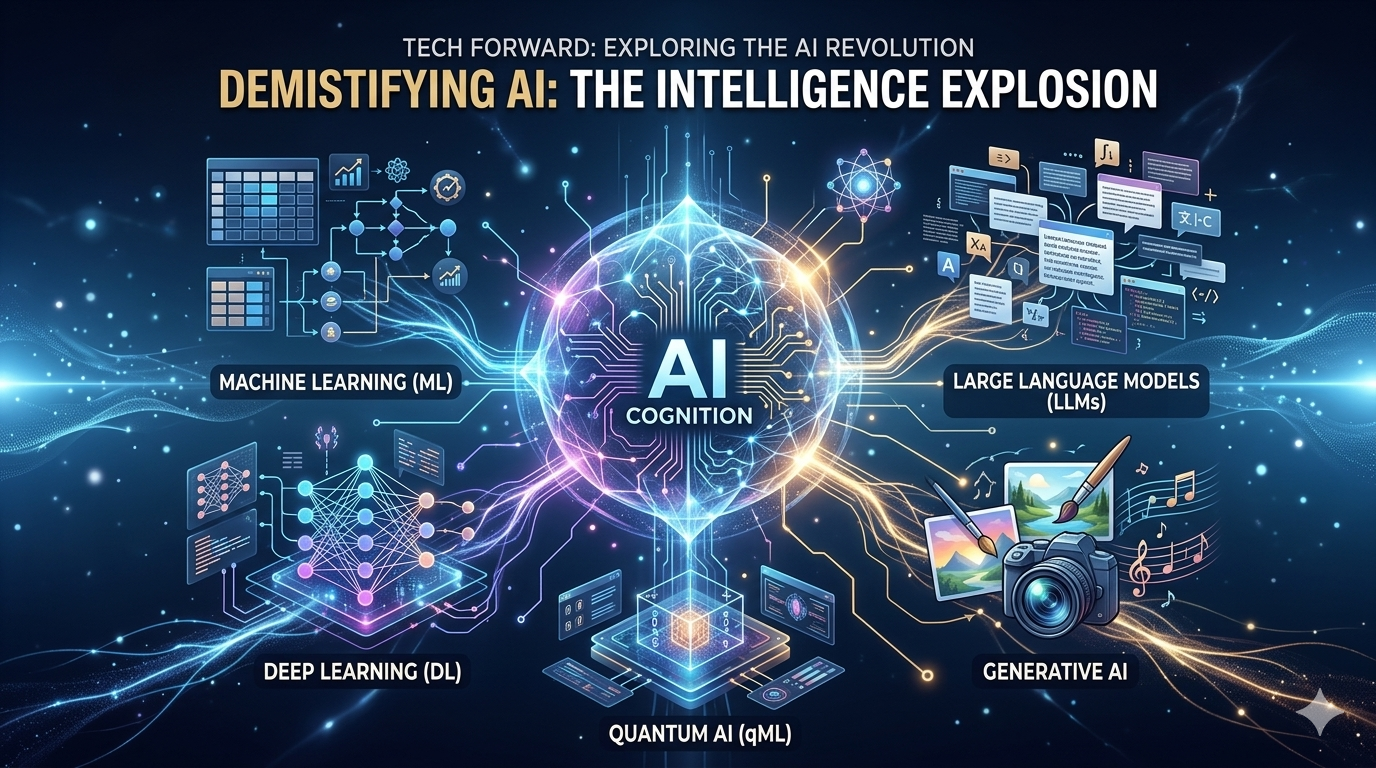
The image above provides a powerful visualization of how this cognitive augmentation is happening. Let’s break down the key AI approaches depicted, from the specialized to the theoretically world-shaping.
1. Machine Learning (ML): The Foundation of Learning
This is the cornerstone of modern AI. At its simplest, Machine Learning involves feeding computers vast amounts of data, which they use to identify patterns and learn how to perform a specific task without being explicitly programmed for it. When you see Netflix recommend a show or Google categorize your photos, you are seeing ML in action.
-
Key Concept: Teaching by example, not by rule.
-
The Hub: Notice how “Machine Learning” acts as a central hub, feeding and informing nearly every other approach in the network diagram. It’s the engine driving the AI revolution.
2. Deep Learning (DL): The Neural Brain
Deep Learning is a highly specialized subset of Machine Learning. It’s inspired by the structure and function of the human brain, utilizing complex layered systems called “artificial neural networks.” By processing data through multiple layers, DL models can grasp incredibly intricate, abstract patterns. This approach has driven recent breakthroughs in computer vision and natural language processing.
-
Key Concept: Layered neural networks, capable of extreme feature extraction.
-
The Power: It’s what enables autonomous cars to see pedestrians or generative models like Midjourney to “understand” and create stunning art.
3. Large Language Models (LLMs): The Art of Understanding Language
This is the technology that powers popular tools like ChatGPT, Gemini, and Claude. LLMs are DL models specifically designed to understand and generate human-like text. They are trained on virtually all the text available on the public internet, allowing them to grasp context, tone, and even humor.
-
Key Concept: DL applied to massive, diverse datasets of human language.
-
The Impact: They are revolutionizing coding, writing, customer service, and scientific research by offering intuitive, conversational interfaces to complex information.
4. Generative AI: From Consumer to Creator
While LLMs are primarily textual, Generative AI is the broader field of creating new content of all kinds: text, images, music, video, and even 3D objects. This approach doesn’t just analyze data; it uses that data to generate entirely novel outputs. The ability of Generative AI to “understand” abstract prompts like “A cat in the style of Van Gogh” is a testament to the power of underlying DL and LLM technologies.
-
Key Concept: Moving from analysis (ML) to synthesis (GenAI).
-
The Catalyst: This field is rapidly becoming the most visible interface between AI and the public. It’s often fueled directly by the powerful “knowledge” captured by LLMs and standard ML data analysis.
5. Quantum AI (qML): The Future of Processing
This is the most forward-looking concept on the map. Quantum AI represents the convergence of Machine Learning with quantum computing. Quantum computers harness the bizarre properties of quantum physics to solve computational problems that are practically impossible for traditional “classical” computers. By marrying ML algorithms to quantum architectures, we hope to tackle problems—like complex molecular simulation for drug discovery or optimization of global logistics—that are currently insurmountable.
-
Key Concept: Merging the exponential speed of quantum computing with the pattern-recognition power of ML.
-
The Potential: While still theoretical, qML promises to catalyze scientific breakthroughs at a pace that is currently unimaginable.
Conclusion: Navigating the Intelligence Explosion
As our network diagram visualizes, AI is not a monolinear field. It is a diverse and rapidly expanding ecosystem of distinct, yet interconnected, disciplines. The “explosion” isn’t random chaos; it’s the convergence and mutual reinforcement of these different technologies.
Just as Web3 challenges us to think about ownership and data, AI challenges us to think about the very nature of cognition and creativity. Demystifying these different branches is not just an exercise in definitions; it’s an essential first step for anyone seeking to navigate—and shape—the intelligent future.